

By Paula Storm
(Fall-Winter, 2007)
A study of the various items and furnishings used in the Holy Mass and liturgical ceremonies of the Church helps us to better understand and appreciate the truths of our Holy Faith as manifested in the sacred liturgy. This article discusses the altar upon which the Holy Mass is offered and which is a clear physical indication of its sacrificial nature.

Which direction did the apostles face when offering mass?
The altar, the elevated structure in the sanctuary, is where the priest offers the Eucharistic Sacrifice and is the focal point of a church. The word altar comes from the Latin altare which means “a high place.” According to St. Athanasius (296-373 AD), the Apostles followed Mosaic practice and prayed facing the East, because Christ is the Light of the World. Subsequently, the altar has traditionally been placed in the eastern part of the church against or near the wall of the apse.
German liturgist, Klaus Gamber, explains that this has been the practice of the Church since Apostolic times:
“…it can be proven beyond all doubt that there never was a celebration versus populum [facing the people] in the Eastern or Western Church and that at all times everyone (priests and faithful) were turned toward the East to pray ad Domimim [to the Lord].1
“…Priest and people should face in the same direction, toward the altar, toward God, especially for acts of prayer and sacrifice directed toward God. When Mass is so celebrated, the priest is at the head of the people, leading them as it were, expressing by his position the part he takes in divine worship.”2
Why are relics of saints placed in the altar?
In the early Church, Mass was celebrated on the tombs of the martyrs in the catacombs with the altars being portable tables or slabs made of wood. The erection and dedication of stone altars was ordered by Pope St. Evaristus (d.105) with Pope St. Sylvester I (314-335 AD) renewing this practice. During the third century, Pope St. Sixtus II (257-259 AD) declared that Mass must always be celebrated on an altar, and Pope St. Felix I (d. 274 AD) stated the altar was to be placed over the grave of a martyr. This custom of having the altar over a martyr’s grave developed into embedding relics of saints in the altar stone. Later, the Church declared that five crosses must be cut into the altar, one on each of the four corners and one in the center. The place where the relics are inserted is called the sepulchre.
When the bishop consecrates an altar, he seals relics of two canonized martyrs in the central part in front of the tabernacle. The host and chalice are placed on this stone during the Holy Sacrifice of the Mass.
Pope St. Gregory I (590-604) declared:
“…this holy altar at which we assist is constructed of stone, which by nature is common, nothing different from other flags of stone with which the walls of our houses are encrusted, and our pavements are ornamented. But because it is consecrated and dedicated to the worship of God, and has received a benediction, it is a holy table, an immaculate altar, which is no longer to be touched by all, but by priests only, and even by them with veneration.”3

Altars can be immovable (L. altare fixum, immobile) or movable (L. altare portabile, mobile). An immovable altar has three sections: the altar slab or table (L. tabula, mensa), the sepulchre or relic-grave, and the base (L. stipes, basis, titulus). A movable altar must have an altar stone large enough on which to place the host and the chalice, which is inserted into the mensa of the altar.
The altar of a church is erected on a platform 3-5 steps higher than the body of the church and rests either on stone pillars or on a base that is stonework. The Blessed Sacrament is reserved in the tabernacle on this altar. The Roman Ritual (1614) stated that the tabernacle had to be placed either on the main altar or on a minor altar. An 1863 decree of the Congregation of Rites made this a universal practice.
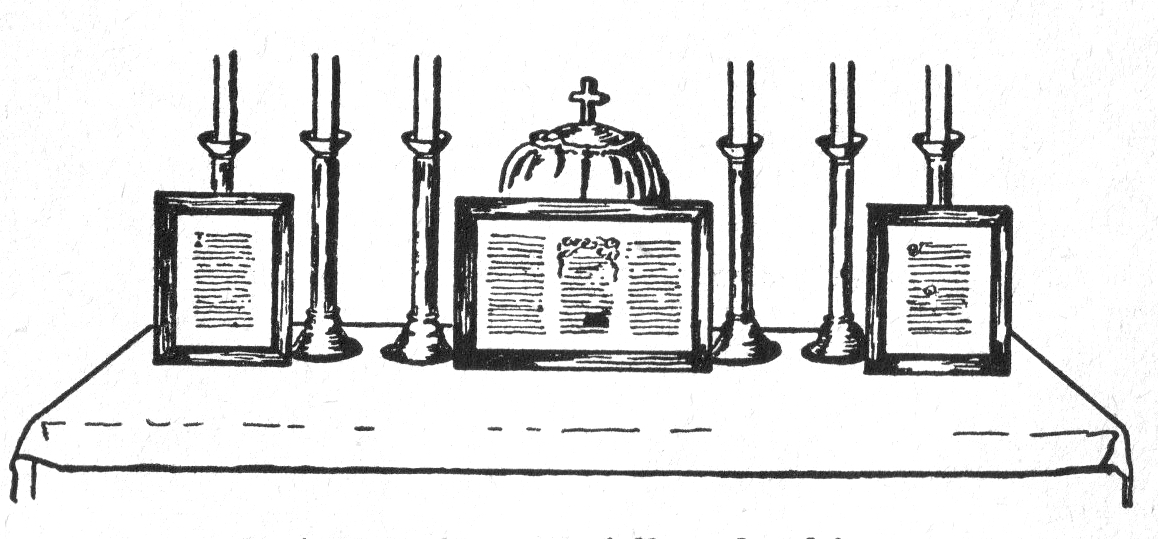
The altar must also have a crucifix and six blessed beeswax candles and must be covered with three cloths of white linen. A sanctuary lamp must burn continuously when the Blessed Sacrament is in the tabernacle. In addition, altar cards, altar vessels, a missal, relics and flowers of suitable materials and ornamentation may also be found on the altar.
When are side altars used?
Originally churches contained but one altar. St. Ignatius stated, “One altar as there is one bishop.” Even when there was only one altar, there were other spaces in the church set aside by the bishop called oratories where Mass could be celebrated. By the fourth century the oratories had gradually developed into side altars. Large cathedrals and churches maintain this custom of having a high altar for the public Mass set apart from the side altars where private Masses or other devotions such as Benediction take place.
A bishop is necessary for both the consecration and the removal of an altar. The consecration of an altar by a bishop is a beautiful and symbolic ceremony. The altar is blessed with Gregorian holy water, also known as Water of Consecration that contains salt, ashes and wine and is used solely during this ceremony. Many ancient prayers are said as the bishop consecrates the altar to God, the Blessed Virgin, all the saints, and especially to the saint in whose honor the church is named. A small metal box anointed with holy chrism and which contains the saints’ relics and grains of incense is then sealed within the altar.
The inspiring words of Fr. Thomas Flynn, C.C. gives us insight as to the centrality of the altar to our Faith: “The beautiful and impressive ritual and liturgy employed in the celebration of the Holy Mass tend to raise our minds to a realization of the great mystery at which we are privileged to assist, which is no less than the mystic renewal of the great Sacrifice of the Cross. The priest ascending the altar, clothed in solemn vestments marked with the Sign of the Cross made by the priest and frequently also by those who assist, all combine to impress upon us the fact that we are joining in offering to the Eternal Father His own Divine Son Jesus who died upon the cross for our salvation and that ‘neither is there salvation in any other.’ (Acts iv. 12.)”4
Footnotes
1 Lucio Brumnelli, 30 days, No.5—1993, “Altar Out of Place,” (as cited by Frs. Francisco and Dominic Radecki, Tumultuous Times, p. 392.)
2 Frederick McManus. Worship, XXXIX. Jan, 1965, p. 125, “Mass Facing the People, (as cited by Frs. Francisco and Dominic Radecki, Tumultuous Times, p. 392.)
3 Rev. Thomas Flynn, Sermons on the Mass, the Sacraments, and the Sacramentals. p. 84.
4 Rev. Thomas Flynn, Sermons on the Mass, the Sacraments, and the Sacramentals, p. 86.
References
Flynn, Rev. Thomas, Sermons on the Mass, the Sacraments, and the Sacramentals, New York, NY: Benziger Brothers, 1919.
Gihr, Rev. Dr. Nicholas, The Holy Sacrifice of the Mass: Dogmatically, Liturgically and Ascetically Explained, St. Louis, MO: B. Herder Book Co., 1938.
Herbermann, Charles G. (ed.) et al, “Altar,” The Catholic Encyclopedia, Vol. 1, New York, NY: Robert Appleton Co., 1907.
New Catholic Dictionary 1910 ed. http://www.catholic-forum.com/saints/ncd00366.htm . Accessed August 13, 2007.
Radecki, CMRI, Frs. Francisco and Dominic, Tumultuous Times, Wayne, MI: St. Joseph Media, 2004.
Stravinskas, Peter M.J., Catholic Dictionary, Huntington, IN: Our Sunday Visitor Publishing Division, 2002.
Sullivan, John F., The Externals of the Catholic Church, New York, NY: P.J. Kennedy and Sons, 1951.
Sullivan, John F., The Visible Church, New York, NY: P.J. Kennedy and Sons, 1942.
–Taken from the Reign of Mary Quarterly Magazine, Issue 128
_-_Altar.jpg)
_-_Altar_stone.jpg)
_-_Altar_cards.jpg)